
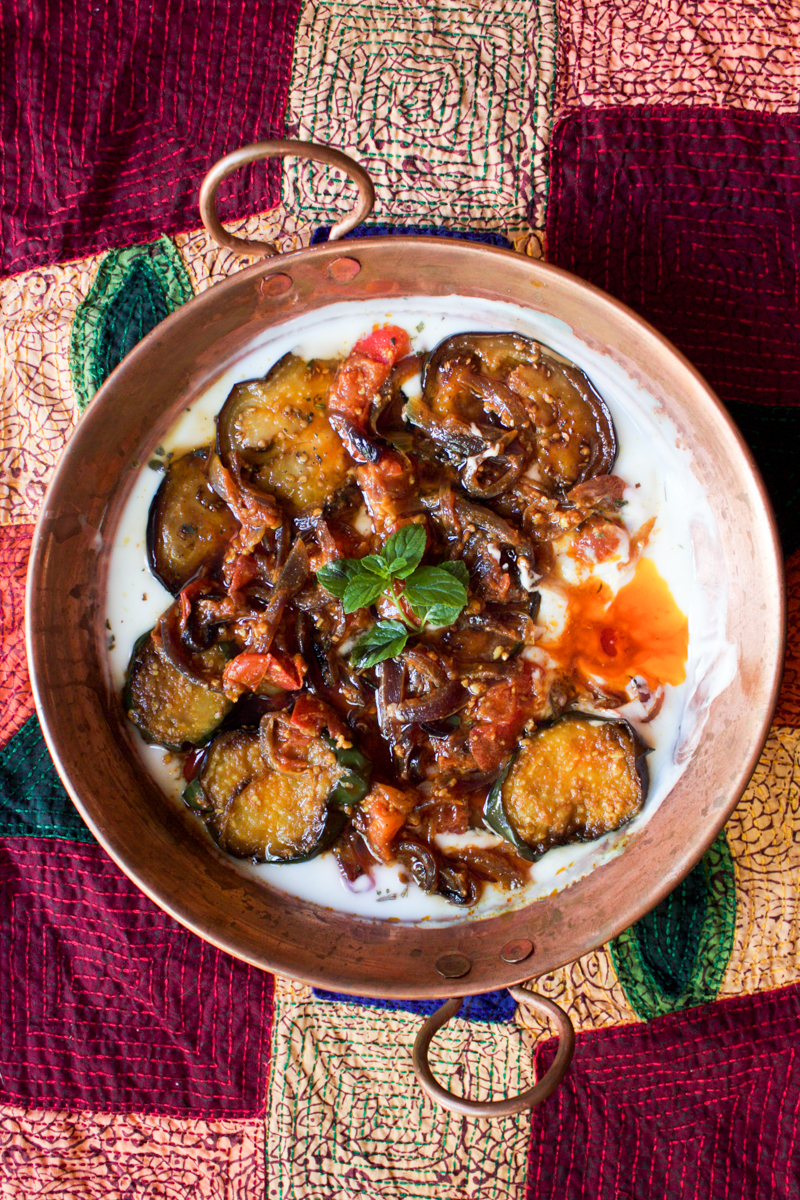
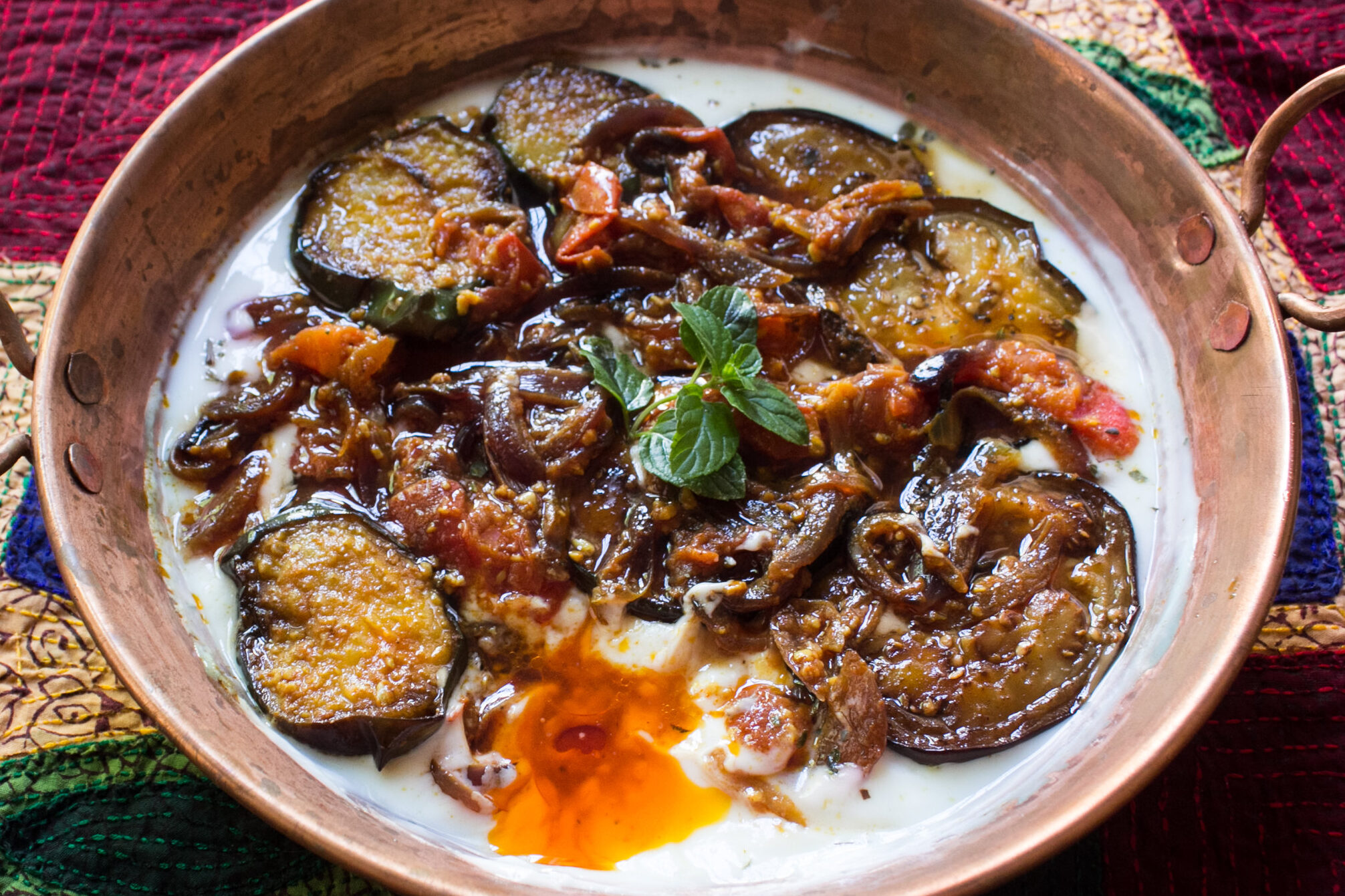
Borani banjan is a classic Afghan dish of tender eggplant simmered in a lightly spiced tomato base and layered with garlicky yogurt. It’s a staple across Afghan homes and has long been part of the broader food culture in Pakistan, especially in cities with Afghan communities. This version stays close to the traditional preparation—layered and tangy —while remaining simple enough for an everyday meal.
Jump to:
What Is Borani Banjan? (Afghan Eggplant with Yogurt Explained)
Borani is a Persian term that refers to a category of yogurt-based dishes found across Iranian, Turkish, and Afghan cuisines. There are many variations, often featuring sautéed or cooked vegetables folded into or layered with yogurt.
Borani banjan consists of fried eggplant that is gently steamed in a rich tomato sauce and then layered over whisked yogurt. While borani banjan looks impressive, it’s fairly straightforward to make and quite pantry-friendly. I’ve been able to find the ingredients easily in every country I’ve lived in.
My friend Nur learned this recipe from her grandmother, who moved to Peshawar from Kabul. It has since become one of my go-to dishes for dinner parties. It’s also a total crowd-pleaser: mildly spiced, widely appealing, and a natural pairing with pulao and kebabs.
A Note on Afghan Cuisine in Pakistan
While I was in Pakistan, I worked on a story for TASTE on Afghan food in Islamabad. Speaking with restaurant owners, students, professionals, I realized how little I knew about a community that had been living in the same city as me for a generation. I wanted to learn more, especially about Afghan home cooking so I reached out to an old student and family friend, Nur.
Nur’s paternal grandmother ("dadi") was from Kabul. She loved to cook and entertain, and showed Nur’s mother, Riffat how to prepare many Afghan classics. Riffat in turn, taught Nur.
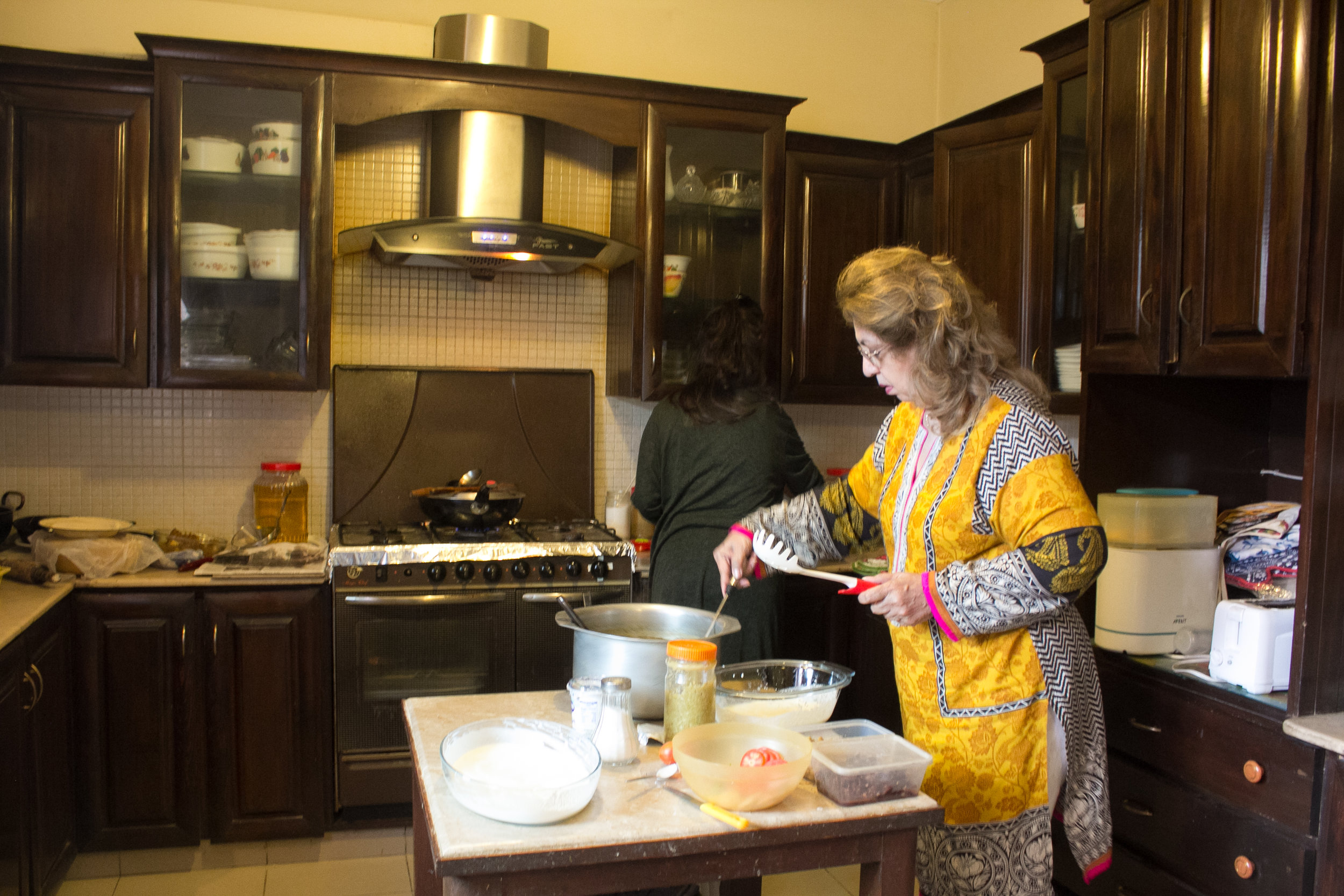
When I went over, there was already pulao on the table but Nur said that she wanted to make something a little more special. Inside the kitchen, there was a line of colorful ingredients — bright red roma tomatoes, spring onions, spinach, dill, mint, eggplant, onions, green chilies, red beans, chickpeas — chopped, prepped and ready to go. We were going to be making Ash, an Afghan spaghetti or an Afghan soup (depending on how you want to look at it) and Banjan Borani (or Borani Banjan.) I was thrilled.
Needless to say, I had a blast and left Nur and Riffat's home happy, with a full belly.
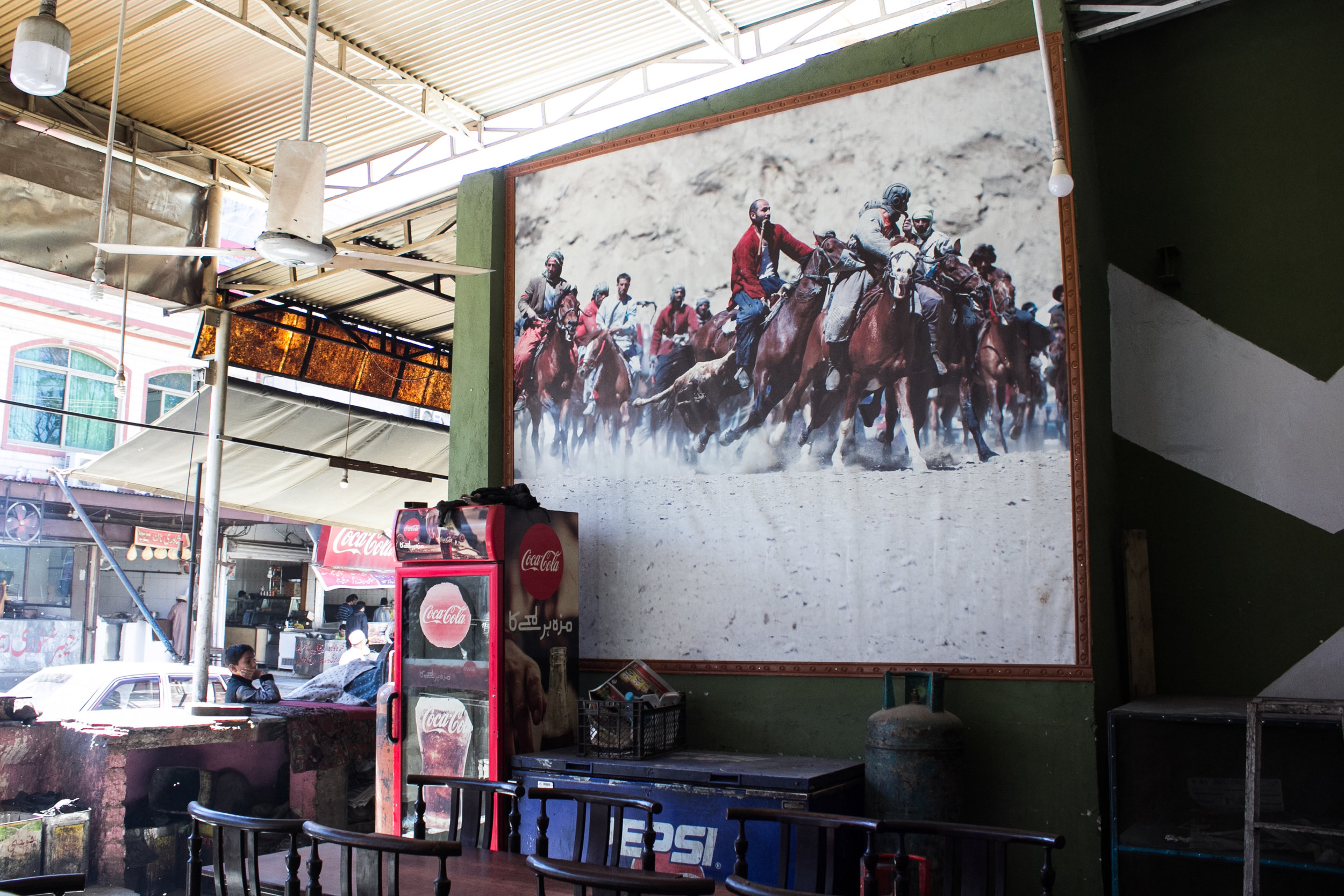
As I began to compile the notes and photographs from our cooking session, my story for TASTE, End of Afghan Cuisine in Pakistan? got published. When my friend, Mehreen, a reporter shared the story, we were hit with a barrage of xenophobic tweets about Afghans. While this is probably nothing new for Mehreen or any other journalist writing about Afghan refugees or the Pashtun Tahafuz Movement, it was certainly surprising for me. As I began to go down the black hole of the #GoAfghaniGo hashtag, my head began to spin.
I was reminded of how I felt during an interview when I had asked a Pakistani restaurant owner and long time resident of Peshawar Mor, often referred to as "mini Afghanistan" in Islamabad, whether he mingled with any of his Afghan neighbors. He gave me a slight smile and then whipped out the Pakistani equivalent of a neighborhood watch committee card, saying “It’s my job to keep an eye on things here. Make sure everything stays safe”. My heart sank.
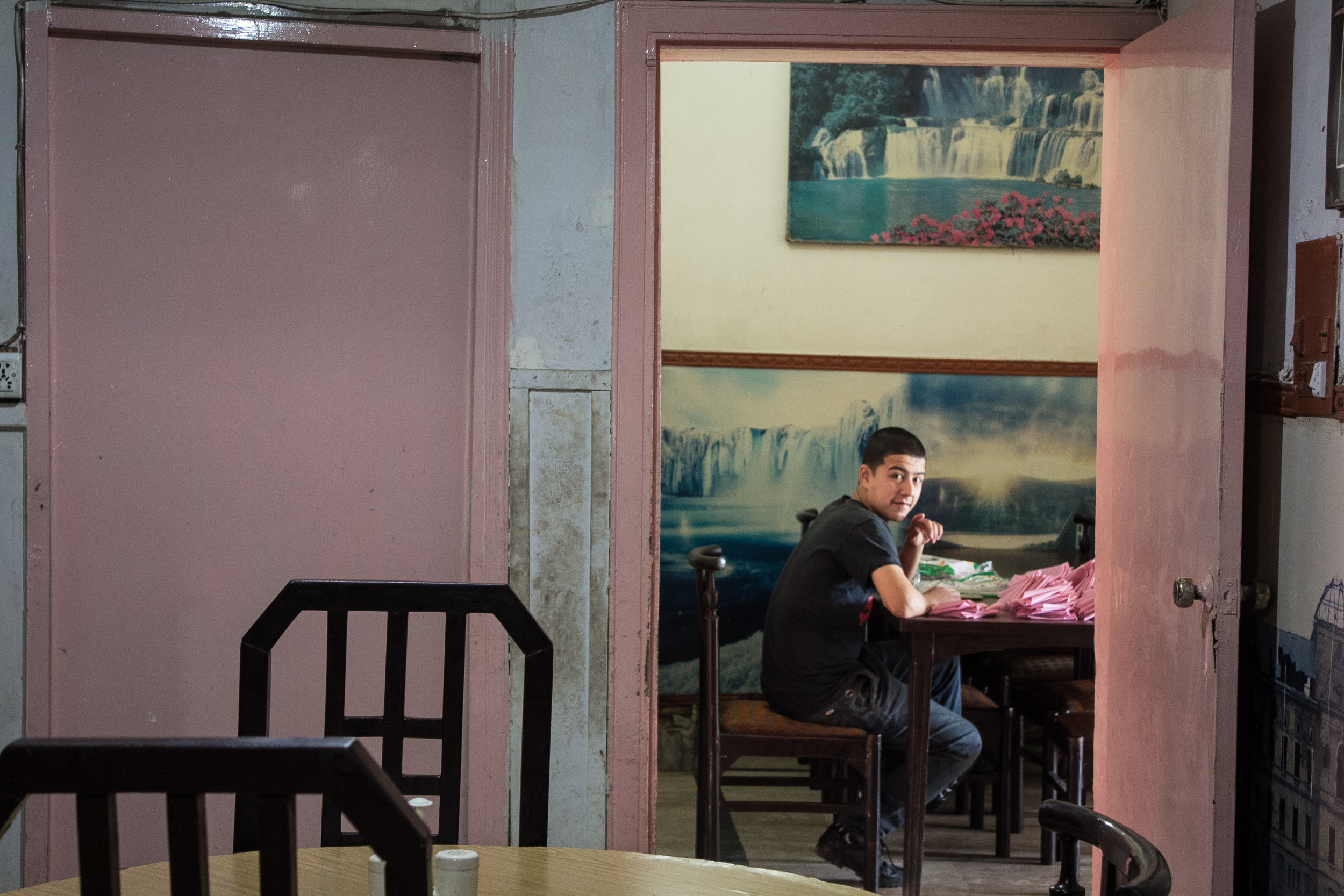
As I was going through the tweets, I was thinking of my colleague, a young Afghan woman who had spent some time in Pakistan after her and her family fled Kabul. While she told me this smiling, eager to swap jokes in Urdu, I was too afraid to ask her any follow-up questions, afraid of what I might hear. I was also thinking of the 17-year old busboy at Khyber Restaurant, who worked 14-hour days to put his younger brother through school. Or Mohammad Ali, a handsome young server who played football every evening at Jinnah Stadium and spoke of how much he loved Islamabad and how this was his home.
Seeing the “alt right” Pakistan script run alongside the “alt right” American script is dispiriting. But when it begins to get too much, you have to remind yourself to take strength from the love and perseverance of others. So I turned my attention to the amazing staff at the Afghan Studies Center of the Center for Research and Security Studies — Sitwat and Saddam — who went out of their way to help with the TASTE story in order to support their own mission of improving cross-cultural understanding between the two countries.
I reminded myself of Zafar Khan, co-founder of Kabul Restaurant who persevered in making his business grow and succeed; hoping for better relations despite what I imagine were decades of living through anti-Afghan hysteria in Pakistan. I thought of the moment when he stopped me just as I was stepping out the door after concluding the interview to say, “Whenever the article comes out and people overseas learn more about the issue, I really hope it can play a small part in helping improve Pakistan-Afghan relations”.
And then of course, I turned my attention to Nur, a young mother of a two-year old who chooses to spend long hours in the kitchen to honor her Afghan heritage.
Ingredients You'll Need
Full-fat yogurt
Indian sour yogurt or lemon juice (optional): For a more authentic finish, fold in a small amount of Indian sour yogurt or whisk in a bit of lemon juice to give the yogurt a tangy finished.
Crushed garlic: You can buy this pre-made or crush it yourself using a food processor or mortar and pestle.
Vegetable oil: While I use vegetable oil, any neutral oil with a high smoke point works.
Italian-style eggplant
Yellow onion: I prefer yellow onions in South Asian cooking, but red onions work in a pinch.
Roma tomatoes: Traditionally used in Pakistan, but vine tomatoes work as well.
Bird’s eye chile or serrano pepper: Use what’s locally available; serranos work well in the U.S.
Salt: I use Himalayan rock salt, but any variety works—adjust to taste.
Turmeric powder
Kashmiri red chili powder: Adds a beautiful color. Substitute with cayenne (use less) if needed.
Pomegranate seeds: Optional, but add a beautiful garnish.
Dried mint: A staple in Afghan cooking that adds a distinctive, cooling aroma.
Red chili flakes: Optional, for added heat and color.
How to Make Borani Banjan
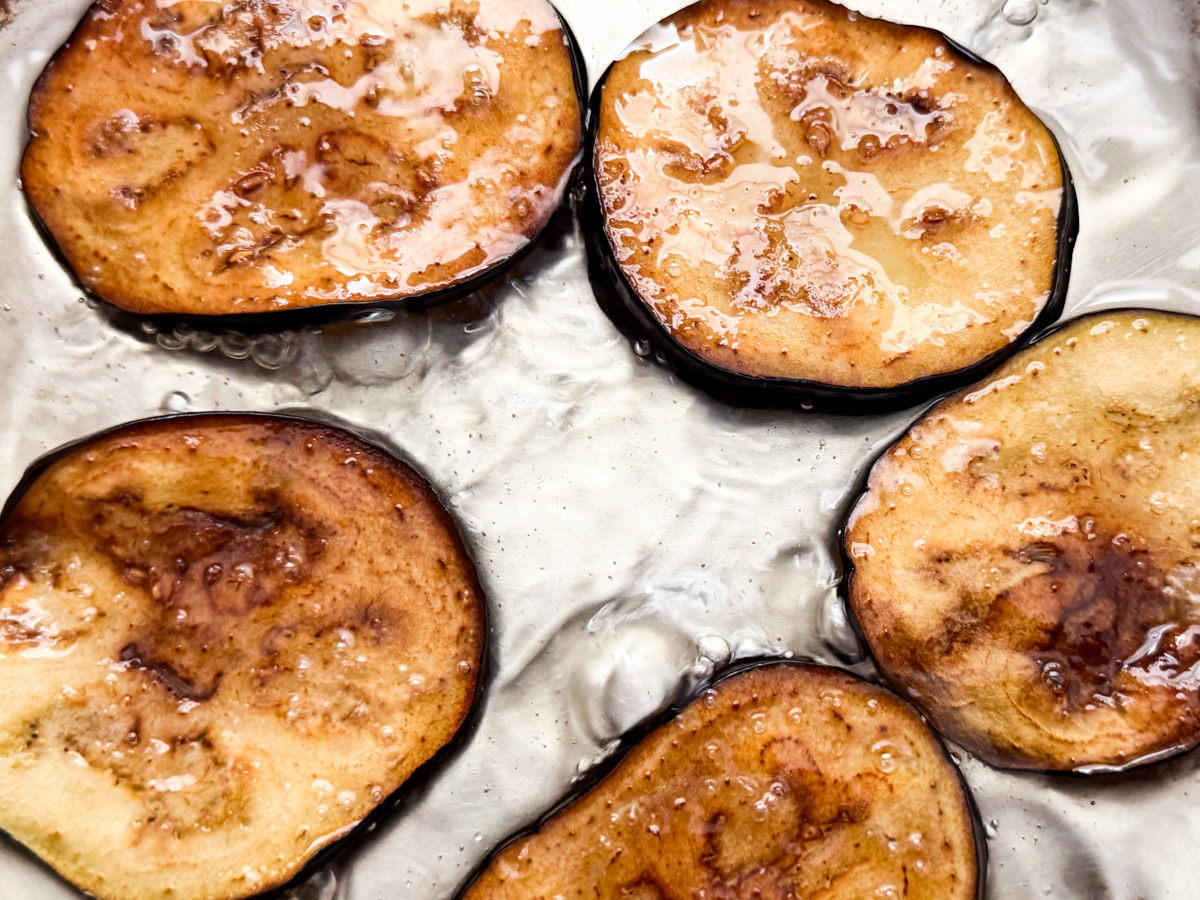
Fry eggplant: Heat oil in a frying pan over medium heat. Once it begins to shimmer, add sliced eggplant in batches and fry for 1 to 3 minutes per side, until evenly golden brown. Adjust heat as needed. Transfer to a plate lined with paper towels to absorb excess oil.
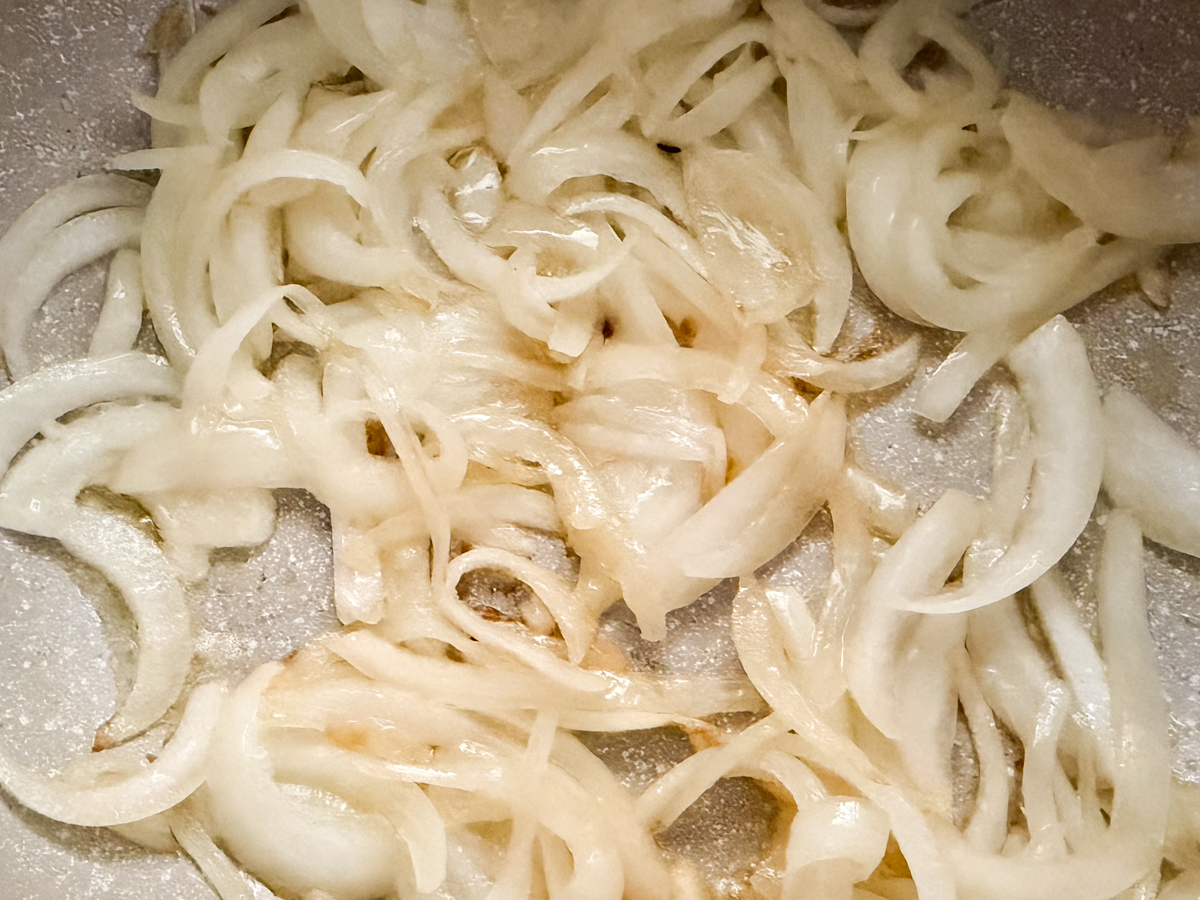
Sauté onions: In a large, heavy-bottomed pot, heat oil over medium-low heat. Add chopped onions and sauté until soft and translucent. Stir in chopped garlic and cook until it no longer smells raw.
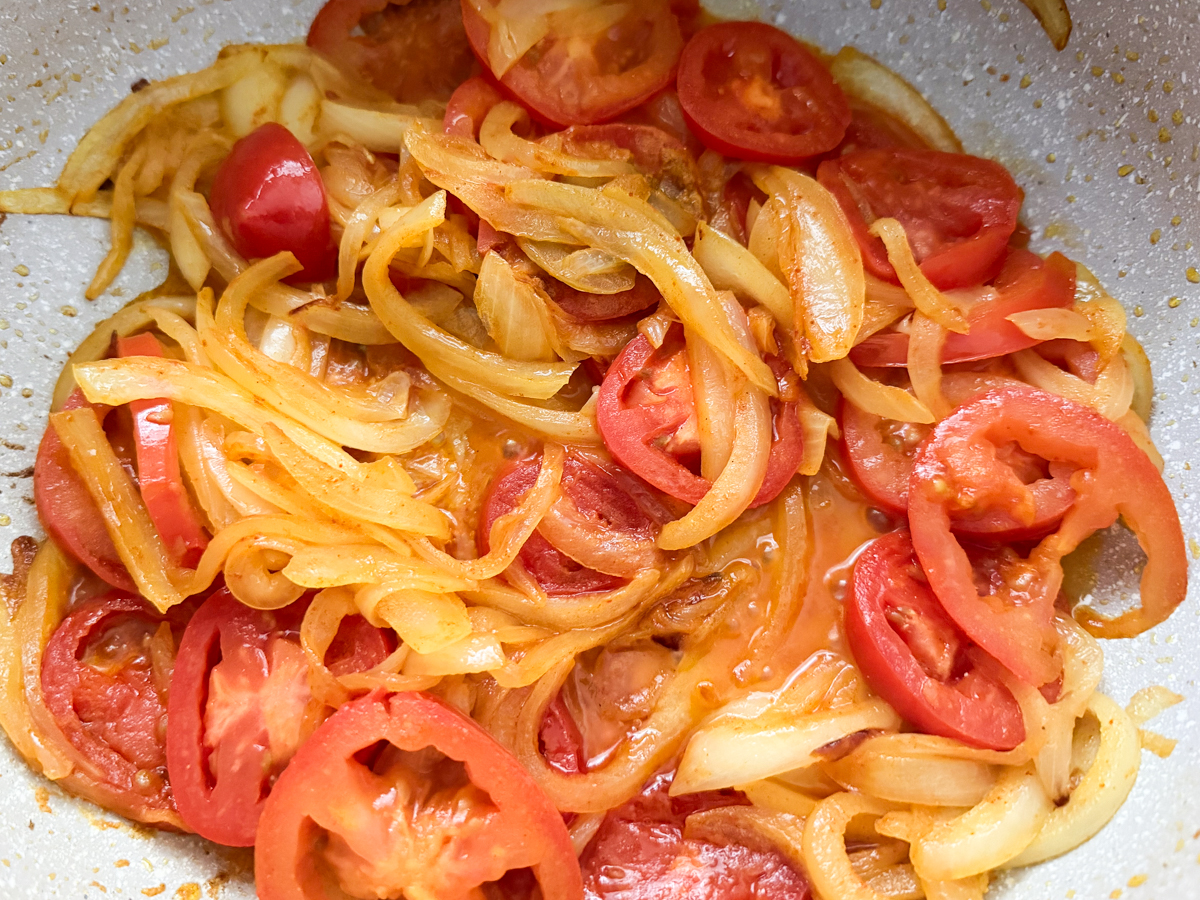
Fold in tomatoes and spices: Increase heat to medium-high and add tomatoes, salt, turmeric, and red chili powder. Stir well, cover, and cook until the tomatoes soften, about 5 minutes.
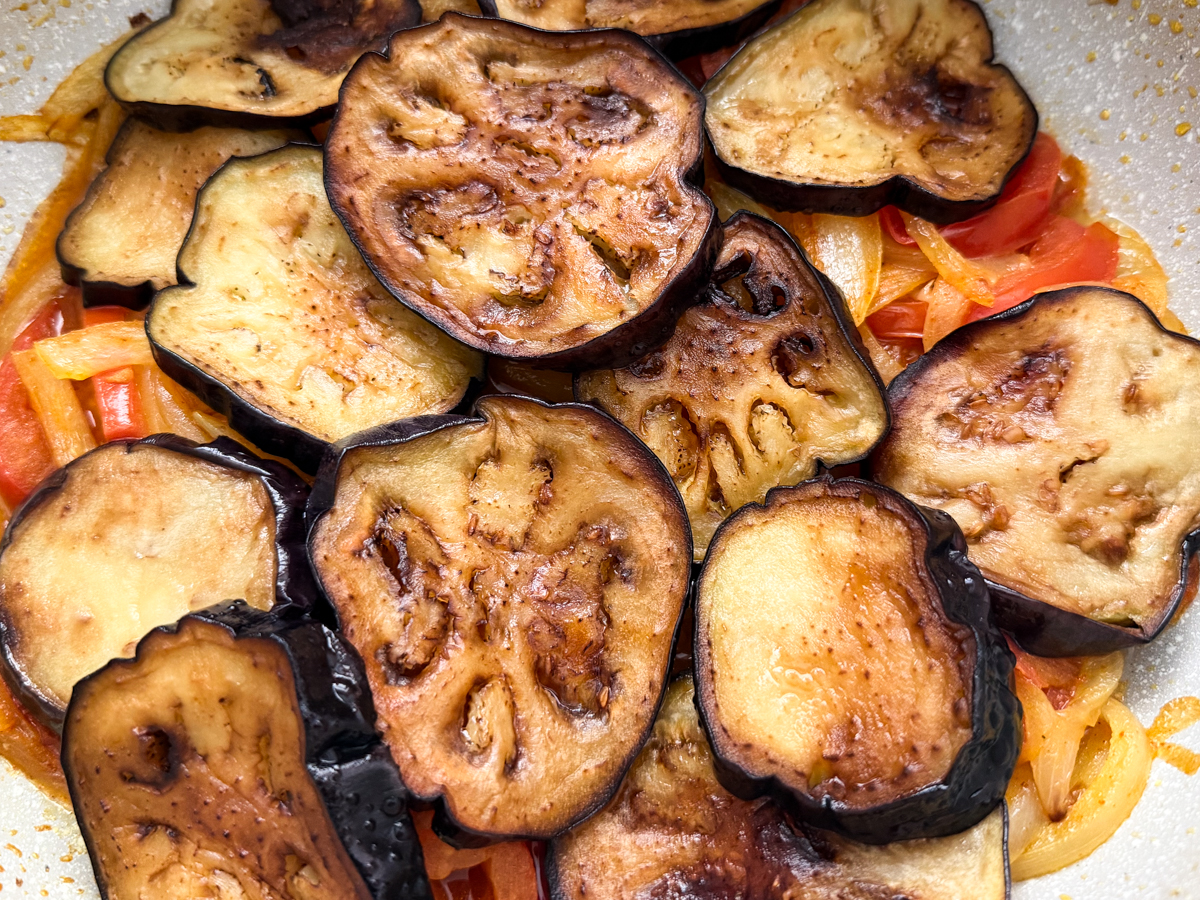
Steam eggplant: Remove the lid and carefully layer the fried eggplant over the tomato-onion mixture. Reduce heat to low, cover again, and let the eggplant steam with the sauce for about 10 minutes.
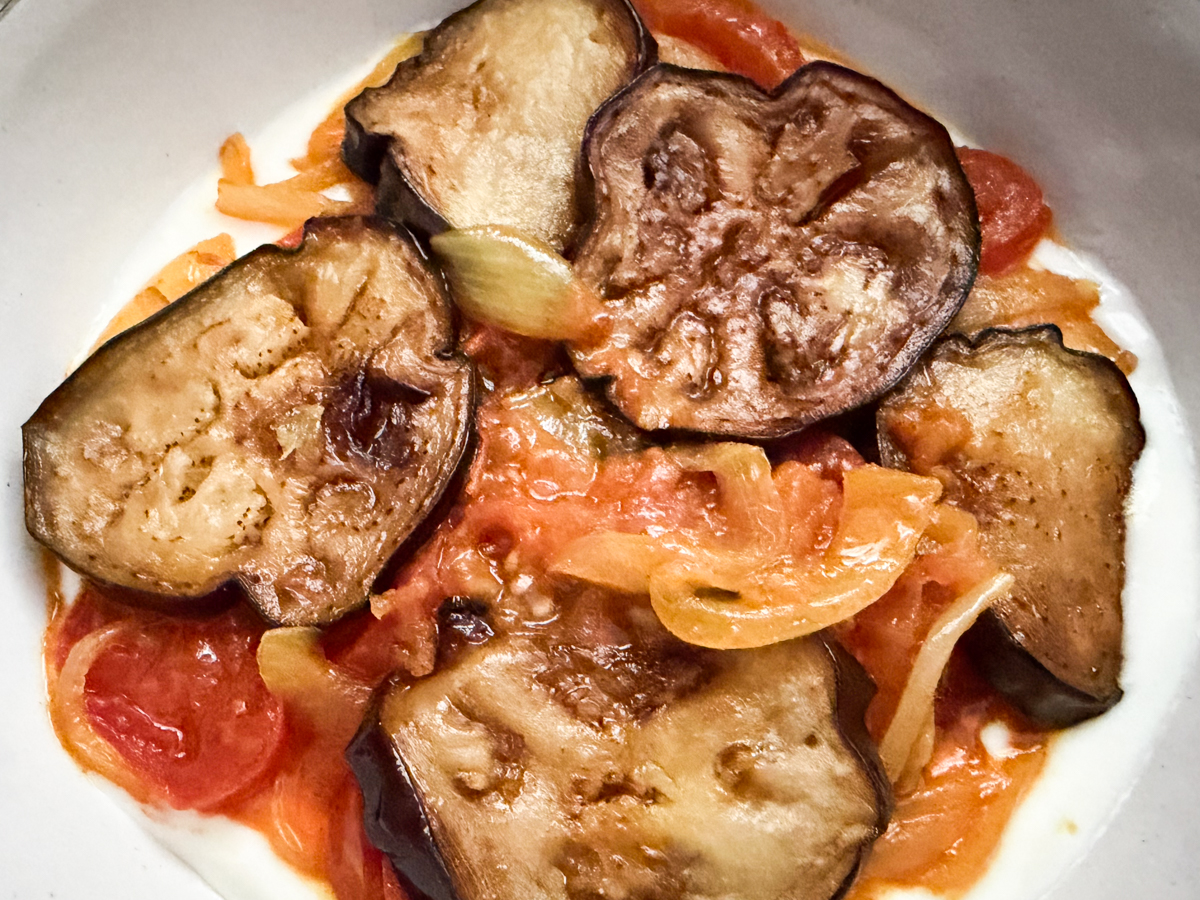
Layer the eggplant, tomato and onion mixture in the yogurt: While the eggplant steams, whisk the yogurt in a large bowl or serving dish and stir in crushed garlic. Once the eggplant is ready, carefully layer it with the tomato mixture over the yogurt. Garnish with pomegranate seeds, dried mint, and red chili flakes.
Tips for the Best Borani Banjan
- I prefer using small Italian-style eggplants. They hold their shape better than the skinnier Asian varieties.
- If you’re unsure about proportions, aim for a roughly equal weight of eggplant, tomatoes, and onions.
- Slightly sour, Indian-style yogurt gives the dish a more pronounced tang. You can also add a squeeze of lemon if needed.
- For presentation, try to keep the eggplant intact when layering so it sits neatly on top of the yogurt.
- Don’t reheat the assembled dish. If preparing ahead, make the eggplant and tomato mixture in advance, then layer it over freshly whisked yogurt just before serving.
What to Serve with Borani Banjan
One of the reasons I love serving borani banjan when hosting is how versatile it is. It pairs well with:
Frequently Asked Questions
Can you make borani banjan ahead of time?
Yes—prepare the eggplant and tomato mixture in advance, then assemble with yogurt just before serving.
Do you need to peel eggplant?
No, the skin softens during cooking and helps the slices hold their shape.
Can you bake instead of fry the eggplant?
Yes, though frying gives the most traditional texture and flavor.
Is it served hot or cold?
It’s typically served warm or at room temperature.

Borani Banjan Recipe
Ingredients
Equipment
Method
- In a frying pan, heat ½ cup of oil over medium heat. When it becomes to shimmer, add the sliced eggplant in batches. Fry each side until a medium brown, 1 to 3 minutes. Adjust heat and time, and add small amounts of oil (1 tablespoon at a time) as necessary. Transfer fried eggplant to plate lined with paper towels to absorb excess oil. Set aside.
- In a large heavy-bottom pot, heat remaining (about ¼ cup) of oil over medium-low heat. Add sliced onions and fry until soft and translucent, about 7 minutes. Add ½ teaspoon of crushed garlic, and fry for a few seconds until it stops smelling raw.
- Add tomatoes, green chili, salt, turmeric and red chili powder. Stir until well-mixed. Cover the pot and let it simmer on medium-low heat for 5 minutes.
- When the tomatoes soften, fold in fried eggplant. Dial heat to low, cover, and let it steam for 10 minutes.
- While the eggplant steams, transfer yogurt to a flat serving dish and lightly whisk until it has an even consistency. Stir in 1 teaspoon of crushed garlic.
- When ready, remove the saucepan from the stove. Carefully spoon the eggplant, tomato and onion mixture, and layer it on top of the whisked yogurt. Garnish with dried mint, red chili flakes and pomegranate seeds.


Kiran says
This is one of my favourite vegetarian dishes to make - my version of making it is different - definitely trying this out. Thank you for sharing the story behind the recipe and the insight into Afghani cuisine in Pakistan.
pakistaneats says
Thank you so much Kiran!
Maymoona says
Just to point out, Afghani is the Afghan currency. The correct term to use when speaking of something or someone from Afghanistan is Afghan.
We live our banjan borani absolutely delicious ?
Delores DelVecchio says
Very special. Very comforting. Making it 3-4 times a year now. This is the last batch with fresh local produce. ??
Athina says
Absolutely delicious! My husband and I have both made this recipe (on different occasions, on our own) and it has always turned out great - proof of how easy it is to follow. Bookmarked for life ❤️
Kathleen says
I came across your NUr's Banjan Borani.
I had an eggplant, yogurt, leftover tin tomatoes, I loved it. I used 2 cups of yogurt for 1 eggplant.
But I used to much oil or perhaps the slices could have been thicker.
Very nom nom nom. Thank you
Jane says
This was really delicious, made with eggplant from my local farm stand and tomatoes from my garden. Thank you for the recipe and the enlightening story.
pakistaneats says
Thank you so much! This made my day.
Sally says
Wonderful!!! I sliced the eggplant, sprayed slices with oil, and baked on cookie sheet until lightly browned instead of frying. Less oil that way and no oil splatter to clean up. Also added 1/2 tsp cumin and some sesame seeds to the tomato mixture. Very filling dish; perfect for a main entree with some Jasmine rice or for a side dish if want a smaller portion.
pakistaneats says
This review made my day Sally! So glad you were able to successfully adapt the recipe to your preference. Thank you for taking the time to leave a review x
Ash says
Very filling and delicious dish!
I followed your instructions and added just a spoonful of coriander powered.
Thank you for sharing this beautiful vegetarian dish!
Greetings from Germany
Delores DelVecchio says
Really delicious. Light, comforting, full of texture and flavor. New experience in cuisine for me, too.
pakistaneats says
That's so wonderful to hear. Thanks so much for trying the recipe and taking the time to review it!
Izzah says
Simple yet delightful recipe. Thank you, Maryam!
Agata says
The best recipe.
Amy A says
I had tried a similar version from another YouTube chef and this recipe was hands down so much more tastier.
I added a teaspoon of dried mint and 1 tablespoon of lemon juice to the yogurt.
Thank you for sharing the recipe.
pakistaneats says
Hi Amy - thanks so much for trying this recipe, and leaving a review! I'm so glad that you enjoyed it.